Learn To Step Outside Of Your Comfort Zone. Outside your comfort zone is where the magic happens


Uni & Uni Admissions
SAT Course Information

Many students take the SAT for the first time in the spring of their junior year, and then again in the fall of their senior year to improve their score.
The SAT is offered nationally seven times each year, in March, May, June, August, October, November, and December, usually on a Saturday.
Every SAT administration has a regular registration deadline and a late registration deadline. The regular deadline is roughly four weeks before the test date and the late deadline is about two weeks before the test date. There’s an extra fee for late registrations (unless you're using an SAT fee waiver) so we recommend that you register as early as possible to avoid fees. Also, the later you register, the less choices you'll have for your testing location and/or date combination.
Format:
The SAT last three hours and has 154 questions which contains three sections:
- Reading
- Writing & Language
- Math (No Calculator & Calculator Sections). The Math section is comprised of a single test with two components - a no-calculator portion and a calculator-allowed portion)
The maths section is as follows:
- 58 multiple–choice questions (broken up into a 20-question non-calculator section and a 38 questions calculator-allowed section)
- 80 minutes long (25 minutes for the non-calculator section; 55 minutes for the calculator-allowed section)
Although most of the questions on the Math Test are multiple choice, 22% are student-produced response questions, also known as grid-ins. Instead of choosing a correct answer from a list of options, you'll need to solve problems and enter your answers in the grids provided on the answer sheet.
The SAT is scored out of 1600 points (your raw score will be converted into this scaled score - see the scoring section below).
| Component | Time Allotted | Number of Questions |
| Reading | 65 mins | 52 |
| Writing and Language | 35 mins | 44 |
| Math |
80 mins (25 mins non calc and 55 mins calc) |
58 (20 non calc and 38 calc)
|
| Total | 180 mins | 154 |
Note: There used to be an optional essay (liek the ACT still has), but this portion of the SAT became optional in 2016. Many students still chose to write it to demonstrate strong or improved writing skills to prospective colleges, however in June 2021, the College Board opted to discontinue the SAT essay.
Formula Sheet:
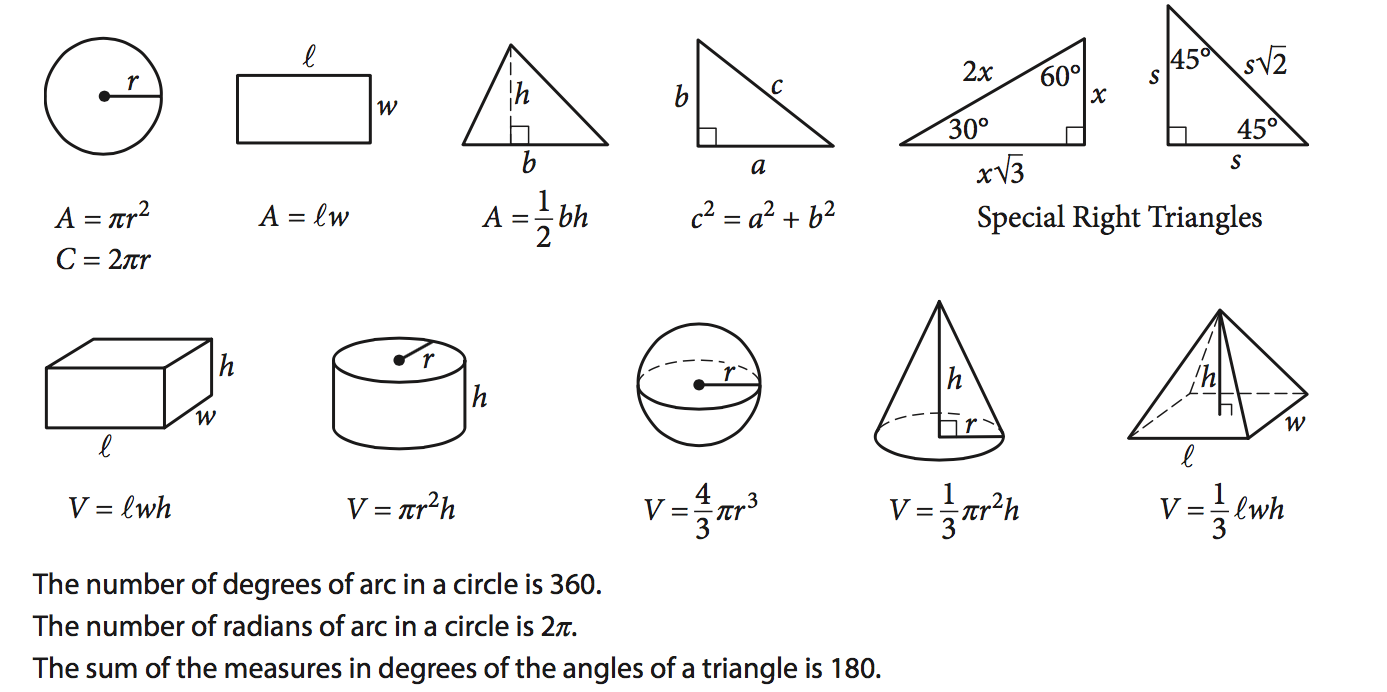
Unlike with ACT, you do get some equations on test day of the SAT. The SAT provides a Reference Sheet with each of the two math sections on the test. I don’t recommend you spend too much time committing these formulas to memory; however, you do need to be familiar with these equations. In other words, if you have no clue how to use these equations, it does you no good to get them for “free” on test day. The SAT is giving them to you because the reality is, they want to test your ability to use the equations, not your ability to memorize them. So make sure you know how and when to use them! That’s really important. If you don’t know how to use the equations, you’re doing yourself no good to memorize them at all!
Content:
Among these two sections of the test, SAT math covers 4 main topics:
- Heart Of Algebra - This makes up about 30% of the math questions you’ll see. This includes all things linear – linear equations, linear graphing, linear functions and linear inequalities. Even though the content in this category is the “easiest,” it’s not uncommon for students to struggle on it because most of this material is taught in middle school, and by your junior year of high school, it’s expected to be a little rusty on it.
- Problem Solving & Data Analysis - This section is made up of stuff that most students have spent the least amount of time covering during math class. This category is also about 30% of the questions on the math sections, and focuses on statistical surveys, rates, ratios, models, and data in tables
- Passport to Advanced Math - Another 30% of the questions, this category has the hardest questions for most students. This portion is the uglier cousin to the heart of algebra questions; it includes things like algebra without exponents and non-linear graphs and functions.
- Additional Topics Questions - Additional topics only makes up 10% of the questions, but it’s the catch-all for every other math topic that the other categories don’t cover, which makes it broad and relatively difficult. These topics could include geometry, trigonometry, and complex numbers. Even though the least amount of questions are dedicated to these topics, you should still be spending some time familiarizing yourself with them to be fully prepared.Topics include Algebra I and II, geometry, and some trigonometry
Some of the skills required to answer the no calculator questions include:
- Simple math (addition, subtraction, multiplication and division)
- Simplifying single equations or phrases (using the FOIL method)
- Solving a system of two equations
- Knowing square roots (or being able to find a square root by multiplying)
- Being familiar with powers (and how to reconfigure powers i.e. write numbers with the same base).
Calculator Usage:
Don’t bring a brand-new calculator in on the day. Bring one you know. Practice for the test using the same calculator you’ll use on test day, so that you are familiar with it.
The SAT is less strict than the ACT with which calculators are not allowed. Most clacualtors are permitted except ones whicg have a computer-style (QWERTY) keypad, pen input, or stylus.
Remember, there is also a part of the maths test which is non calculator and you will not be allowed ot use your calculator.
Scoring:
You're given a point for every question you get right (there's no penalty or point deduction for wrong answers).
The SAT has two big sections for scoring:
- Evidence-Based Reading and Writing (this is the two Reading and wrting & Language sections grouped together)
- Math
Your raw score is simply the number of questions you answered correctly and hence the number of questions is the maximum raw score for each section. The scaled score is converted from the raw score you earn on each of the 2 sections. You can earn a scaled score of between 200 and 800 points on each section, for a total of 1600 possible points on the SAT. It is scored on a 200 to 800 scale in each section in 10-point increments. This relatively small scale means that small improvements in your score can make a big difference in your percentile rank (sometimes, a 10-point increase in your score can boost your percentile rank by 5 points).
The reason the SAT (as well as other standardized tests) uses scaled scores is to make sure their scores are consistent across multiple test dates. Scaling is not curving your score relative to the scores of other students who take the test the same day as you. What scaling does is analyze average scores for each version of the SAT to ensure that not test date is easier or harder than another. However, the process of scaling means that on different editions of the SAT, raw scores can translate to scaled scores differently. In other words, these numbers aren’t set in stone, but they can give you an idea of what raw score to shoot for on each section.
Your raw scores are converted into scaled scores (on the 200-800 scale for both sections) using a table, which changes for every SAT test date. The reason that the table changes is to ensure each test is standardized; in other words, it accounts for differences in content difficulty. The table is used to equate easier SAT tests to harder SAT tests.
To calculate your maths score:
- Figure out your raw score on each of the two math sections (No Calculator and Calculator). This is just the total amount of questions you answered correctly.The No Calculator section has 20 possible points, while the Calculator section has 38 possible points. Blank or wrong questions do not count for or against you. For the Grid-In answers, where you fill in the answer rather than choosing A, B, C, or D, remember that there can be a few different ways to write the same answer (for example, 3/5 could also be written as 0.6). As an example, let's say I count 15 correct answers on the No Calculator Section, and 25 correct answers on the Calculator section. I ignore wrong or blank answers as I count, since there is no deduction for wrong answers.
- Add your non calculator raw score to your calculator raw score. This is your final Math raw score. The highest possible raw score is 58. To continue my example, I would add 15 (my raw score on the No Calculator section) to 25 (my raw score on the Calculator section) for a final Math raw score of 40.
- Using the table below, find the scaled score of 200-800 your raw score matches to.
While the exact conversion varies by test date the following table is a good guide:
| Scaled Score | Raw Score |
| 0 | 200 |
| 1 | 200 |
| 2 | 210 |
| 3 | 230 |
| 4 | 240 |
| 5 | 260 |
| 6 | 280 |
| 7 | 290 |
| 8 | 310 |
| 9 | 320 |
| 10 | 330 |
| 11 | 340 |
| 12 | 360 |
| 13 | 370 |
| 14 | 380 |
| 15 | 390 |
| 16 | 410 |
| 17 | 420 |
| 18 | 430 |
| 19 | 440 |
| 20 | 450 |
| 21 | 460 |
| 22 | 470 |
| 23 | 480 |
| 24 | 480 |
| 25 | 490 |
| 26 | 500 |
| 27 | 510 |
| 28 | 520 |
| 29 | 520 |
| 30 | 530 |
| 31 | 540 |
| 32 | 550 |
| 33 | 560 |
| 34 | 560 |
| 35 | 570 |
| 36 | 580 |
| 37 | 590 |
| 38 | 600 |
| 39 | 600 |
| 40 | 610 |
| 41 | 620 |
| 42 | 630 |
| 43 | 640 |
| 44 | 650 |
| 45 | 660 |
| 46 | 670 |
| 47 | 670 |
| 48 | 680 |
| 49 | 690 |
| 50 | 700 |
| 51 | 710 |
| 52 | 730 |
| 53 | 740 |
| 54 | 750 |
| 55 | 760 |
| 56 | 780 |
| 57 | 790 |
| 58 | 800 |
Finding your Evidence-Based Reading and Writing scaled score is a bit trickier than finding your Math score, since you have to combine your performance on the Reading and Writing sections. This will not be listed here, since this is a Math website.
Top Univeristy Requirements:
You’ll want to look at the SAT averages for the schools you’ll apply to. Different universities have different admission standards, and any score above or at their cut-off may be considered a good score. For the Ivy League, competitive scores range between 1500-1550. For other highly competitive schools, it's above 1400
For Maths:
- 690-800 is considered a very good score
- 600-680 is a competitive score
- 530-590 is above average
- 520 or lower is below average
The SAT also gives you a number of subscores: two that rate your ability in different subjects (History/Social Studies and Science), and seven that break down the Math, Reading, and Writing sections into more specific skills.
Syllabus Changes:
The SAT changing its format is nothing new and happens almost every decade.
2016-2023
The last significant redesign of the SAT was in 2016 when the exam went from its 2400-point format back to 1600 points and students were no longer penalised for wrong answers. The changes were as follows
- Two sections instead of one - one section with a calculator and one without. It was longer good enough for students to just focus on tricks and trying to eliminate answer choices. The SAT wanted to stop students just picking an answer, but instead justify their answers.
- No longer allowed calculators on every portion of the exam.
- More focus on data analysis and real world problem-solving, algebra and some more advanced math concepts – areas that most prepare students for college and career
- Less emphasis on geometry - geometry took up about 25-35% of questions on the old SAT, but it will now account for less than 10% of questions on the new SAT. The questions will remain relatively the same, but there will simply be less of them. Also, somewhat ironically, although the number of Geometry questions is decreasing, the College Board decided to give you more Geometry formulas in the reference section, which is at the beginning of the SAT Math sections. The reference section lists some formulas and laws for you to use when answering questions.
- Increased focus on algebra - algebra now accounts for more than half of the questions in the SAT math section. While algebra was always a part of the math section, it's now being emphasized even more. These questions can be very tricky because they ask you to apploed algebra in unique ways. Some of the algebra skills required to succeed on the SAT math section include solving linear equatoons, solving a system of equatons, creating linear equations or system of equations to solve problems (used in the example below). Also creating, analyzing, solving and graphing exponential, quadratic, and other non-linear equations.
- Increased focus on modelling - these quesyions ask you to think about what equations or models mean. You will be a given a model or equation and asked to explain what certain parts mean or represent. These questions are weird because they're asking you to do something oyu rarely d0 - they ask you to analyze the significance of a number or variable in context rather than solve the equation
- More advanced topics such as trigonometry (trig was never asked before but now acocunts for as many as 5% of questions) and complex numbers (the intriduction of i).
2023 onwards
There is an upcoming SAT makeover which is the most significant change yet. College Board, the entity that carries out the SAT exam, recently announced that the standardised test will be undergoing a major makeover from 2024 onwards. SAT will move from a pen-and-paper mode to 100% digitised. In addition to moving to a digital format, the exam length will be shorter, the reading passages will be easier, and the test questions will be more adaptive.The SAT will be almost an hour shorter in time in 2024.
This huge change will occur in 2023 for internationals and 2024 for US students.
You might be wondering why the change to digital? There are reasons
- Covid-19 had a great effect on had on the accessibility and flexibility of the SAT
- The College Board is a business, and businesses need to generate profit. Recently, the College Board has been generating significantly less revenue given that fewer students are taking the SAT compared to years past because of the shift to test-optional college admissions. Digital Tests Are Cheaper To Administer.
So, if you’re prepping for the SAT now, this most likely won’t affect you (unless you’re really getting a head start). Because most students don’t take the SAT until their junior year of high school, we can expect the first set of students to experience the new test to be the class or 2025. If you’re interested in reading more about the changes to the format of the test.
Tactics:
2016-2023
Since there is a non-calcualtor portion of the new SAT math section, you need to be prepared to do math without a calculator! Practice lots of mental maths and make sure you're sharp on your basic math skills (adding, subtracting, multiplying and diviiding - including for fractions too). Also, make sure you know some common square roots and square numbers.
Practice makes perfect! Practice a lot in general. For the non calculator section, realistic practice makes perfect! Make sure you do every SAT practice test available. Don't use your calculator on the non-calculator section and see how you do! To get really good at your mental math you must stick to the real testing conditions.
Spend most of your study time on algebra and also get familiar with the advanced topics.
- Trigonomatry - don't worry about spednign too much time on this since it acocunts for less than 5% of questions, but be sure to know how the unit circle work and the basic trig formula (SOHCAHTOA, radians, special triangles, swapping from one trig function to another and complementary sine and cosine angle relationships, Pythagoras) and how to use and apple them
- Complex numbers - don't worry too much. There are usually only 1-3 questions on this questions per test.
Practice:
2016-2023
Although the changes to the new SAT math section might feel major, they're actually relatively subtle. There has been a slight shift in the material covered, which means there needs to be a shift in how much time you spend studying certain math topics. The questions asked are generally more straightforward than those on the previous SAT math. The major changes to maths are
- Less geometry (down to less than 10%)
- More algebra and modeling (50% or more of the test)
- Trigonometry and complex numbers have been added
- You're not allowed to use your calculator on one portion of the math test
Change your study strategy by:
- Knowing your mental math
- Focusing your time on algebra
- Learning trigonometry and imaginary numbers (but not spending too much time on them)
All SAT tests below are good practice, even the old ones pre 2016! Make sure you complete the latest ones first though and then if you have no more to practice, do all the older papers too!
The best way to combat mental exhaustion is by practice. There is no fool proof method to stop your brain from being exhausted when taking the SAT. But with practice and studying, you can get more comfortable with the test and work around your mental exhaustion to a degree. The easiest way to get there isn’t by repeatedly taking practice tests. Instead, try to employ deliberate practice. Figure out which problems are most challenging for you (maybe the reading section?) and just practice that until it’s second nature.

Maths Revision and Resources For All Maths Courses
What are you waiting for? It's time to get started!

Simple, easy to understand Maths