Why TMUA?
The TMUA is used for maths and maths related degrees such as economics and computer science. In recent years, predicted grades have become less relevant within university admissions, meaning the TMUA is much more important to making your application stand out (although the other parts of your application will still need to be strong).
For many unis, TMUA is a non-compulsory exam. This means that many of the universities that use the TMUA give applicant’s the opportunity to apply for their courses without submitting TMUA results. The key exceptions to this are Cambridge, Imperial, LSE, Durham, UCL and Warwick, who require all applicants (excluding mature students) to sit the TMUA for various courses, including computer science and economics courses and your results will automatically be sent through. Since your results will not be automatically sent to the non-compulsory universities, you'll will need to submit them yourself once you have received them.
When Should You Start Preparing
The ideal time is to start six-months in advance. The majority students start around August for an October sitting.
Syllabus
The TMUA is based on content typically covered within Higher Level GCSE maths and AS level maths. It is much eaier than the MAT and STEP.
The TMUA test is meant to be challenging. You will be taking it if you are applying for a maths or maths-related degree at a highly prestigious university. You and your fellow candidates will all have performed exceptionally well in your public exams and have high predicted grades, so one way to differentiate between you is by getting you to sit a difficult maths test!
If you have effectively prepared and are confident with you mathematical abilities, then the TMUA should be more than possible to succeed in. At first glance, the TMUA may seem like a fairly easy test. That’s not to say that the TMUA is easy an take it for granted though, as these questions will be testing you on advanced level maths. You’re going to need to be confident with maths up to A-Level difficulty (or equivalent), so some of the topics covered will be fairly new to you. Everything covered will be in your school curriculum however.
Be aware that paper 2 may trip you up if you haven’t properly practiced it. These questions rely more on mathematical reasoning than just pure mathematics, so the logic-based questions may catch you off guard.
Differences Between MAT, Step and TMUA
STEP is generally thought to be harder than the MAT and significantly harder than the TMUA. STEP is more similar to A-levels though than the MAT. The STEP is considered harder because the MAT doesn't require as advanced mathematical knowledge.
The MAT always has a more "logic puzzle" spin to it which is reminiscent of many maths challanges. There are two STEP papers (paper 2 and 3) and applicants for Maths are usually required to take both papers. In contrast, there is only one MAT paper.
TMUA is based on AS Level and Higher Level GCSE Mathematics, whereas STEP is based on AS Level and A Level Mathematics.
Paper Structure
More universites are now using the TMUA and the setup has changed since 2024. Previously (pre 2024) the test was a paper-based exam with only a single sitting in October.
Now (since 2024) the papers are now computerised (takes place on computers in Pearson VUE centres) and are on two consecutive days. There are 2 sittings (October and January and 2 days are offered in each sitting). A candidate can only choose one setting and both have different sets of questions. Either sitting is acceptable for applicants to LSE but applicants are strongly encouraged to take the first sitting as this will allow the widest availability of time slots and locations.
You cannot use a calculator (or dictionary) for the test, but you will be given a data booklet to do your working out in.
There is no formulae sheet, so ensure you learn all the relevant formulae.
Paper Specifics and Content
The duration and number of papers did not change in 2024. There are two papers each lasting 75 minutes. Each paper has 20 multiple-choice questions.
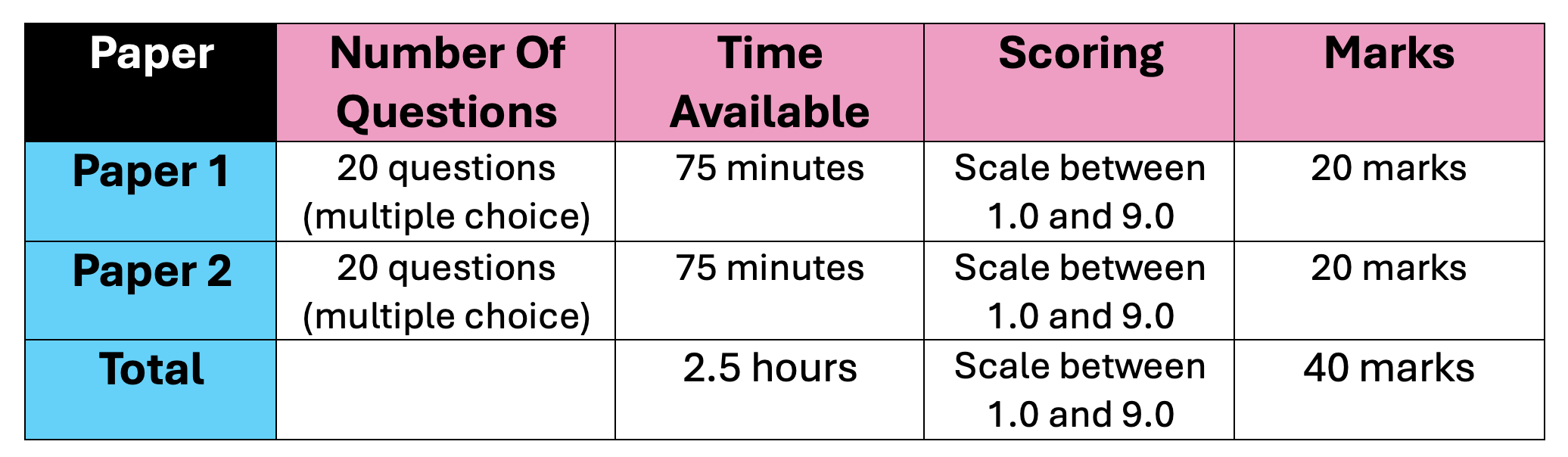
- Paper 1: Appplications of Math Knowledge - questions assessing pure maths in new unfamiliar situations (be able to apply your knowledge of maths in new situations)
- Paper 2: Mathematical Reasoning - questions assessing mathematical reasoning and logic
Paper One (Applications of Mathematical Knowledge)
Part One - almost all is covered by the pure maths AS Level
● Algebra and functions
● Sequences and series
● Coordinate geometry in the (x, y) plane
● Trigonometry
● Exponentials and logarithms
● Differentiation
● Integration
● Graphs of functions
Part Two - almost all covered by in GCSE higher maths
● Units
● Number
● Ratio and Probability
● Algebra
● Geometry
● Statistics
● Probability
Paper Two (Mathematical Reasoning)
You will need to know the topics mentioned for paper one above, but paper two focuses on mathematical reasoning and logic. You will need to demonstrate that you understand and can construct mathematical arguments.
Practice
One of the best ways to prepare for the TMUA test is by doing practice tests because they will get you used to the style of questions
TMUA do not release their new online tests, but the older physical past papers cover the same content and have the same style of questions as the computer-based test. Thay are not online tests though, so obviously they will not fully prepare you for your TMUA test, but they are good enough.
Scoring Guide
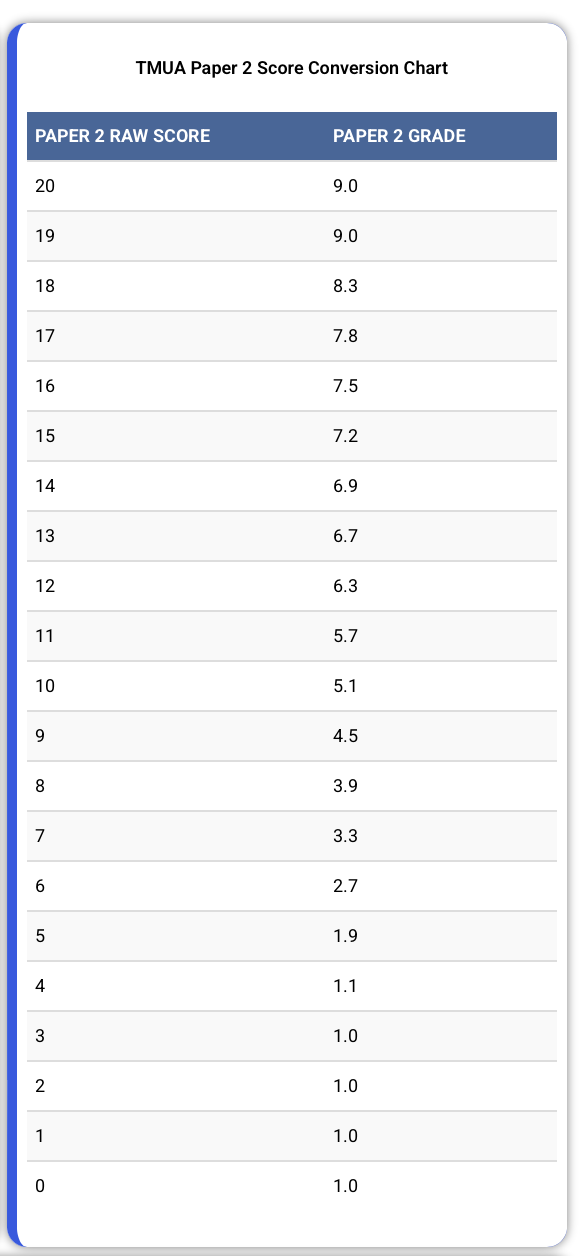
There is no pass or fail for the TMUA. You should aim to do the best you can. Your final scores are based on the number of correct answers you give. The papers are of equal weighting, and no marks are deducted for incorrect answers, so it’s worth attempting all questions. Each question is worth one mark hence you can work your score out of 20 for each paper you do. Your raw marks are converted and placed into a scale from 1.0 to 9.0.
The following is a rough guide, but of coruse they vary year to year.
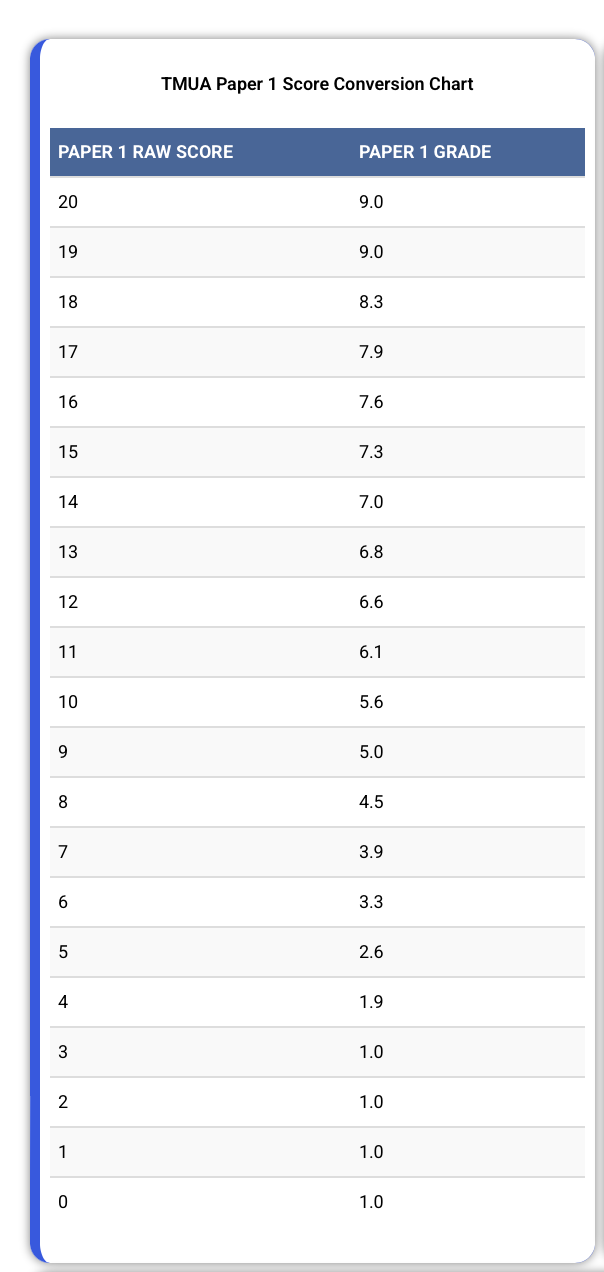 .
. 
You are given a score based on your overall performance on both papers (not separate scores for each paper) hence out of 40 which is given on a scale of 1.0 to 9.0 where 1.0 is low and 9.0 is high (results are given to one decimal place). This is the score that your prospective universities will see.
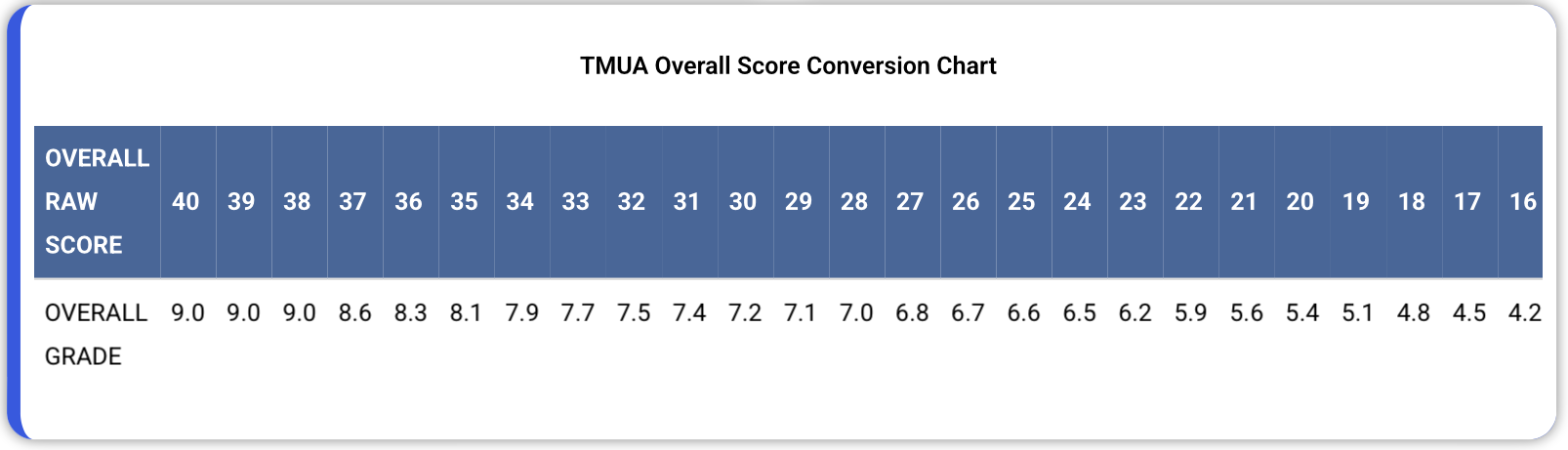
The decimal scaled score allows scores on different versions of the test in different test sittings to be reported on a common scale. Scores are statistically equated. This means the results of candidates taking different versions of the test can be reported on a common scale.
Scores To Aim For
Scores range from 1-9.
4.5 is an average score. The majority of students score between 3.0 and 5.0.
6-7 is considered a good score and safe for related math degrees such as economics and computer science. A good score to always aim for is 6.5+.
7-8 is considered very good and safe for entry to math degrees (at least a 7 without mitigating circumstances). Only about 10% of candidates score higher that 7.
Maths degrees students should aim for at least 14 raw marks per paper or 28 raw marks overall. Economics and computer science studnets should aim for at least 12 raw marks per paper or 24 raw marks overall.
As already mentioned, for applications to most universities, you can decide whether or not you want to share your results with the university after you have received them. This means TMUA gives you a risk-free opportunity to prove your potential, and in some cases to receive a reduced offer. However, for applications to the University of Cambridge (Economics and Computer Science) TMUA is compulsory (except for mature students) and all results will be shared automatically with the University of Cambridge.
Results
Candidiates should receive their results approximately 4-6 weeks after the exam is sat.
Resits
Students cannot attempt the test twice during the same admissions cycle. If you apply again in another admissions cycle, you must take the test again.
Some universities do accept alternate admissions tests, including the MAT and STEP, so be sure to take one of these exams if you’re unhappy with your TMUA score.



 2017 Paper 1PDF